
Blog
Farm Equipment Appraisal for Bankruptcy: What Trustees and Owners Need to Know
A farm equipment appraisal for bankruptcy has to answer a legal question, not just a market question, since Chapter 7 liquidation, Chapter 12 reorganization, and cramdown all call for different value standards on the same tractor. This guide breaks down which standard applies, what trustees expect on Schedule A/B, and how to get a report that holds up in court.
When a farm files for bankruptcy, the value of the equipment on the lot often decides the outcome of the case. A combine worth $180,000 at retail might be worth far less at a forced auction, and worth something else entirely if the farmer plans to keep using it under a reorganization plan. Getting the right number, tied to the right legal standard, is the difference between a smooth case and a fight with a secured creditor.
This guide walks through how bankruptcy chapter, intended use, and legal standard interact for farm machinery, and what a farm equipment appraisal for bankruptcy needs to include to satisfy a trustee, a secured creditor, and the court.
How the Bankruptcy Chapter Determines Which Value Standard Applies
The same piece of equipment can carry three or four different "correct" values depending on which chapter the farm files under and what the equipment's fate is in that case. A trustee liquidating assets under Chapter 7 needs a forced-sale number. A farmer keeping a tractor under a Chapter 12 plan needs a replacement value. There is no single answer to "what is this equipment worth in bankruptcy" until you know the intended use.
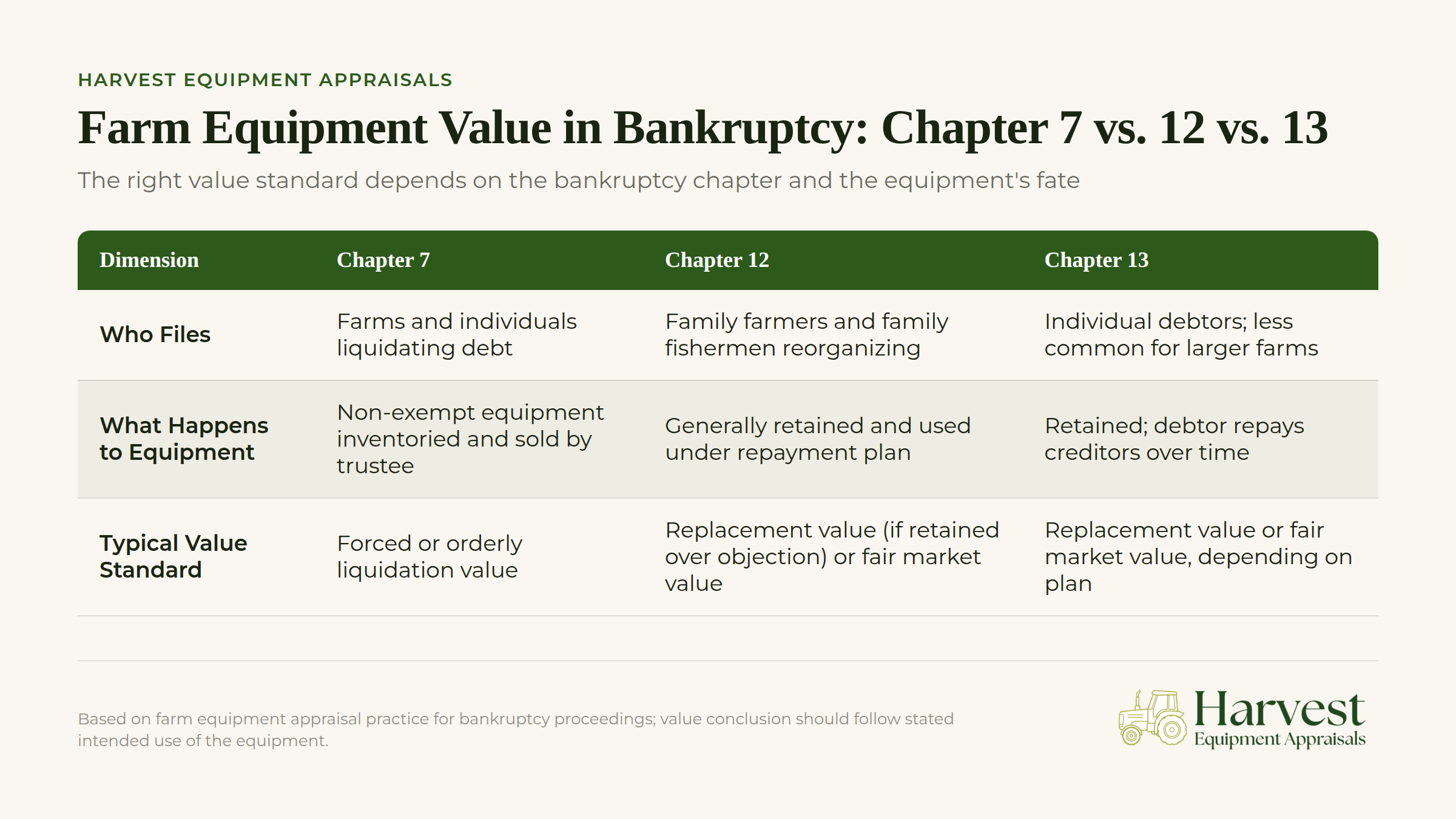
Farm bankruptcies generally run through one of three chapters, and each treats equipment differently.
| Chapter | Who Files | What Happens to Equipment | Typical Value Standard |
|---|---|---|---|
| Chapter 7 | Farms and individuals liquidating debt | Non-exempt equipment is inventoried and sold by the trustee | Forced or orderly liquidation value |
| Chapter 12 | Family farmers and family fishermen reorganizing | Equipment is generally retained and used under a repayment plan | Replacement value (if retained over creditor objection) or fair market value |
| Chapter 13 | Individual debtors, less common for larger farm operations | Equipment is retained; debtor repays creditors over time | Replacement value or fair market value, depending on the plan |
Our certified tractor appraisal engagements are built around this distinction: the report states the intended use up front, and the value conclusion follows from it, rather than defaulting to a generic "market value" figure that may not hold up when a secured creditor objects.
Chapter 7 Liquidation: Forced Sale of Farm Equipment
Chapter 7 is straight liquidation. The debtor's non-exempt property, including farm machinery, is identified and sold, and the proceeds are distributed to creditors according to priority. A court-appointed trustee administers the sale and typically engages an appraiser to establish what the equipment will actually bring.
Under Federal Rule of Bankruptcy Procedure 6005, a trustee may employ an appraiser only with court approval, and the court's order has to fix the appraiser's compensation before the work is billed. The rule also confirms that no residency or licensing requirement disqualifies a qualified appraiser from being hired, which is why trustees can and do work with appraisers outside their home district.
Because the goal in Chapter 7 is converting assets to cash within a limited window, the standard applied is usually forced liquidation value or orderly liquidation value, not fair market value. A tractor that would fetch $95,000 in a private-party sale with normal marketing time might realize considerably less at a compressed auction sale, and the appraisal needs to say so explicitly.
Watch out: Some farm equipment may be exempt from the estate depending on state law, similar to the federal "tools of the trade" exemption referenced in agricultural bankruptcy research. Exempt equipment stays with the farmer and is not sold, so confirming exemption status before an appraisal is scoped can change which assets actually need to be valued.
Chapter 12: The Reorganization Path Built for Family Farmers
Chapter 12 exists specifically for family farmers and family fishermen who want to reorganize rather than liquidate. Eligibility requires that at least 50% of the debtor's fixed, liquidated debts arise from the farming operation, excluding debt on a principal residence unless that debt is itself farming-related. The chapter carries a current aggregate debt ceiling under the Bankruptcy Code, and farm operations that exceed it typically fall back to Chapter 11 instead.
Unlike Chapter 7, Chapter 12 is built around keeping the operation running. Equipment usually stays with the farmer under a court-approved repayment plan, and the appraiser's job shifts from "what will this bring at auction" to "what does it cost to replace this equipment for continued use." Background research on family farm reorganizations confirms that the debt ceiling and farming-income percentage tests are central to whether a farm even qualifies for Chapter 12 treatment in the first place.
Chapter 13: Individual Repayment Plans and Farm Equipment
Chapter 13 works similarly to Chapter 12 in that the debtor repays creditors over time rather than liquidating assets, but it is designed for individuals with regular income and applies caps that make it impractical for larger farm operations. Smaller farming operations or individual farm owners sometimes use Chapter 13 when their debt load fits within its limits.
As in Chapter 12, equipment is typically retained rather than sold. The trustee administers the plan, and an appraiser may be engaged to value collateral for a specific purpose within that plan, such as confirming that secured creditors are receiving payments equal to the present value of their collateral. That value is not automatically liquidation value; it depends on what the plan actually proposes to do with the equipment.
The Rash Standard: Why Replacement Value Applies When You Keep Your Equipment
Key takeaway: When a farmer keeps equipment over a secured creditor's objection in a reorganization case, the applicable value standard is replacement value, not liquidation or foreclosure value.
This distinction comes from Associates Commercial Corp. v. Rash, a 1997 U.S. Supreme Court decision addressing how collateral should be valued in a cramdown, the process by which a debtor retains secured property while paying the creditor an amount tied to the collateral's value rather than the original debt. The Court held that because the debtor was continuing to use the property in the business rather than surrendering it, the correct measure was what it would cost to replace that equipment, not what a forced sale would bring.
For a farm bankruptcy, this matters enormously. A secured creditor holding a lien on a combine will often argue for a low forced-liquidation number, since a lower collateral value can support a larger unsecured deficiency claim. A farmer keeping that combine under a Chapter 12 plan is entitled to have it valued at replacement value instead, which is typically a meaningfully higher figure. The appraisal has to state which standard it is applying and why, because the wrong standard invites an objection from the other side.
Pro tip: If a case involves both equipment being sold and equipment being retained, the report should separate the two categories and apply the correct standard to each rather than using one blended number across the whole equipment list.
Three Value Premises Every Farm Equipment Appraisal Should Define
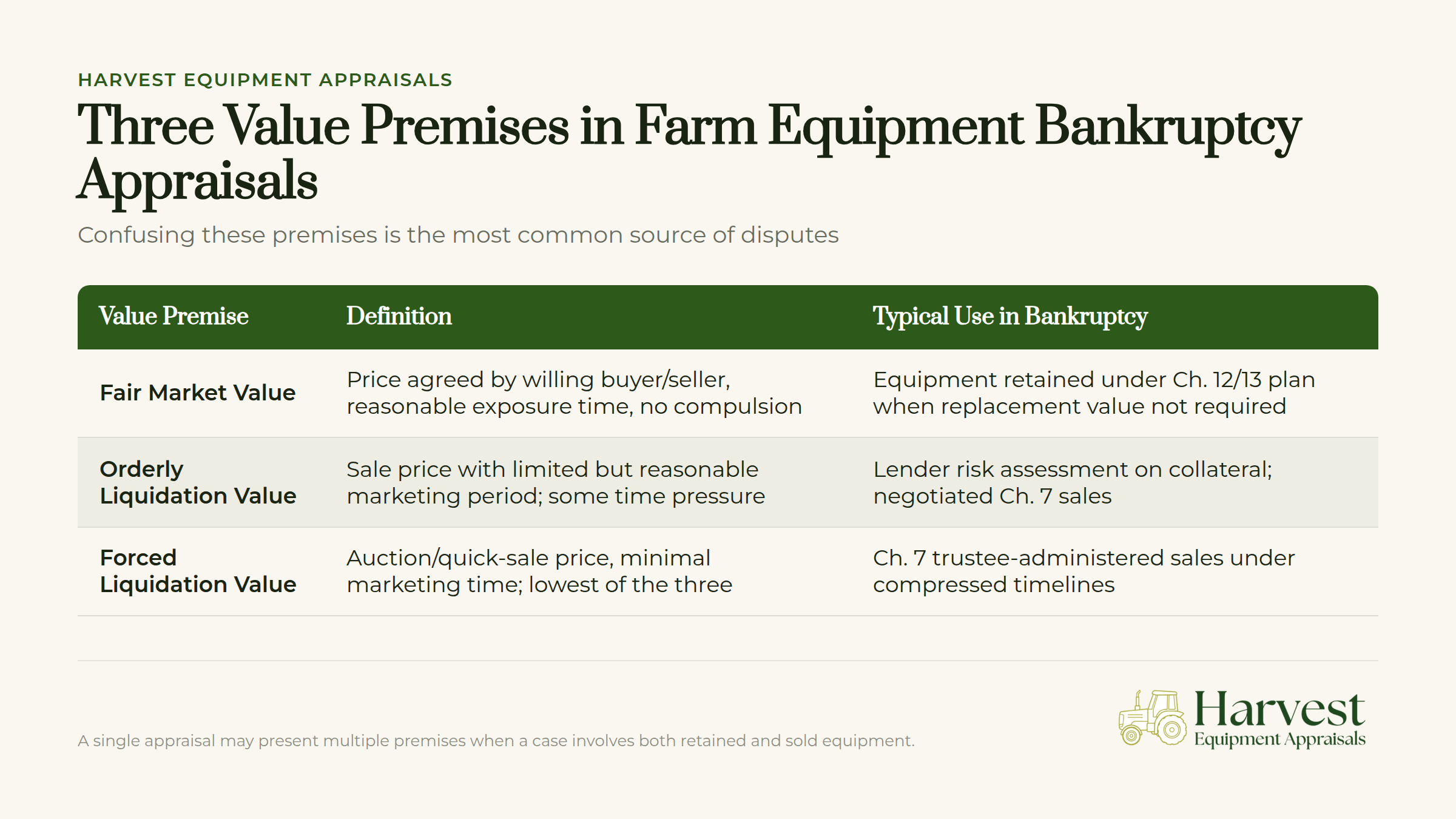
Bankruptcy appraisals for farm equipment generally rely on three distinct value premises, and confusing them is the most common source of disputes.
| Value Premise | Definition | Typical Use in Bankruptcy |
|---|---|---|
| Fair market value | Price a willing buyer and willing seller would agree to, with reasonable exposure time and no compulsion on either side | Equipment retained under a Chapter 12 or 13 plan when replacement value is not required |
| Orderly liquidation value | Sale price achievable with a reasonable, but limited, marketing period; some time pressure exists | Lender risk assessment on collateral, and some negotiated Chapter 7 sales |
| Forced liquidation value | Sale price under auction or quick-sale conditions with minimal marketing time; the lowest of the three | Chapter 7 sales administered by the trustee under compressed timelines |
A single appraisal report can, and often should, present more than one of these premises side by side when a case involves both equipment being sold and equipment being retained. That approach gives the trustee, the secured creditor, and the court a complete picture rather than a single number that only answers part of the question.
Schedule A/B: Why Your Equipment List Anchors the Case
Every bankruptcy filing requires the debtor to list personal property, including farm equipment, on Schedule A/B (Official Form 106A/B). The values reported there become the baseline the trustee, creditors, and the court work from for the rest of the case, so an inaccurate or vague equipment list creates problems well before any dispute over valuation methodology even begins.
A schedule that lists "farm equipment: $150,000" as a single line item invites scrutiny. A schedule built from an itemized appraisal, with each asset identified and valued individually, gives the trustee and any secured creditor confidence that the numbers were derived carefully rather than estimated. This is especially important because Bankruptcy Code Section 541 pulls essentially all of the debtor's legal and equitable property interests into the estate at filing, meaning every piece of equipment with a lien or ownership question needs to be accounted for accurately.
What Trustees and Attorneys Want in an Equipment Appraisal Report
Trustees and bankruptcy attorneys reviewing a farm equipment appraisal are looking for documentation that removes ambiguity, not a rough estimate. A defensible equipment report typically includes:
- Make, model, and year for every piece of equipment, matched against titles or purchase records where available
- Serial or VIN numbers to confirm identity and avoid disputes about which specific unit is being valued
- Hours of use or mileage, since two identical tractors can carry very different values depending on wear
- Condition notes, including mechanical issues, cosmetic damage, and any recent repairs or overhauls
- Lien status, showing whether each asset is unencumbered, fully secured, or under-secured relative to its value
- Stated intended use and value premise, so the reader knows whether the figure is liquidation value, replacement value, or fair market value
Iowa bankruptcy court decisions applying farm equipment exemptions have turned on exactly this level of detail, including whether specific implements qualify under state exemption law for lien avoidance. A generic list without serial numbers or lien status gives the court nothing to work with when that kind of dispute comes up.
Getting an Appraisal Before You Decide to File
Not every farm equipment appraisal happens after a case is already open. Some farmers who are weighing whether to file at all commission a pre-filing appraisal to understand what their equipment is actually worth before choosing a chapter or a strategy. Knowing the real replacement value versus the real liquidation value of a fleet can change the decision entirely, since a farm that looks insolvent under a forced-sale assumption may look viable once continued-use values are on the table.
A pre-filing appraisal also gives an attorney something concrete to work with when advising a client on Chapter 7 versus Chapter 12 eligibility, since the debt-to-asset comparison depends directly on which value standard is assumed.
Preparing a USPAP-Compliant Appraisal for Your Bankruptcy Case
A farm equipment appraisal submitted to a bankruptcy trustee, secured creditor, or court needs to be prepared in accordance with USPAP (Uniform Standards of Professional Appraisal Practice), the standard published by The Appraisal Foundation. Our appraisers hold credentials with organizations such as the ASA, ISA, and CAGA, and every report is structured around the specific intended use and value definition the case requires, not a generic market estimate.
Engagements are quoted as a fixed fee before work begins, based on the number of assets, the complexity of the equipment list, and whether the report needs to support multiple value premises in a single case; fees are never billed hourly and never adjusted based on the value the equipment turns out to be worth. Whether you are a trustee assembling a Chapter 7 sale, an attorney preparing a Chapter 12 cramdown argument, or a farmer trying to understand your numbers before you file, you can request an appraisal and get a report built around exactly the standard your case needs.
This article is provided for general informational purposes only and does not constitute legal, tax, or financial advice. Readers should consult a qualified attorney or CPA regarding their specific circumstances.